News
The OBIS Species Distribution Models among the winners of the GBIF Ebbe Nielsen Challenge 2026
30 September 2026

A Baltic grey seal (Halichoerus grypus ssp. grypus), one of the 12,000+ European marine species that are included in the OBIS Species Distribution Models.
Photo: © Gen / iNaturalist
Each year since 2015, through an open global competition, the Ebbe Nielsen Challenge, organized by the Global Biodiversity Information Facility GBIF rewards the most innovative tools and approaches built on open biodiversity data. The 2026 edition crowned four winners, among them the OBIS Species Distribution Models, a prediction tool for marine species and habitats with a wide range of real-life applications.
Planning for the ocean of tomorrow
Under the triple crisis it is currently facing, the ocean is rapidly changing. Today’s biodiversity-rich areas may become increasingly impoverished in the future. This makes long-term conservation planning a challenge: how to make sure that what we protect today considers how biodiversity will look tomorrow? Initially designed as part of the EU-funded MPA Europe project, the OBIS Species Distribution Models (SDMs) allow users to foresee how the biodiversity in a given marine area will evolve under different climate scenarios.
We can transpose the OBIS Sspecies Distribution Models to any region, and change the scope of species for which we can output these predictions.
“The tool was conceived to identify resilient areas in European waters that would be the best candidates to be protected, considering their biodiversity richness,” explained Silas Principe, OBIS modelling expert and one of the researchers behind the OBIS Species Distribution Models. “Within the MPA Europe project, the OBIS SDMs delivered marine biodiversity predictions for over 12,000 marine species, as part of a prioritization tool combining blue carbon storage estimations, ocean connectivity, and climate velocity. This will provide decision-makers with comprehensive model-based predictions to inform their choice on current and future MPAs.”
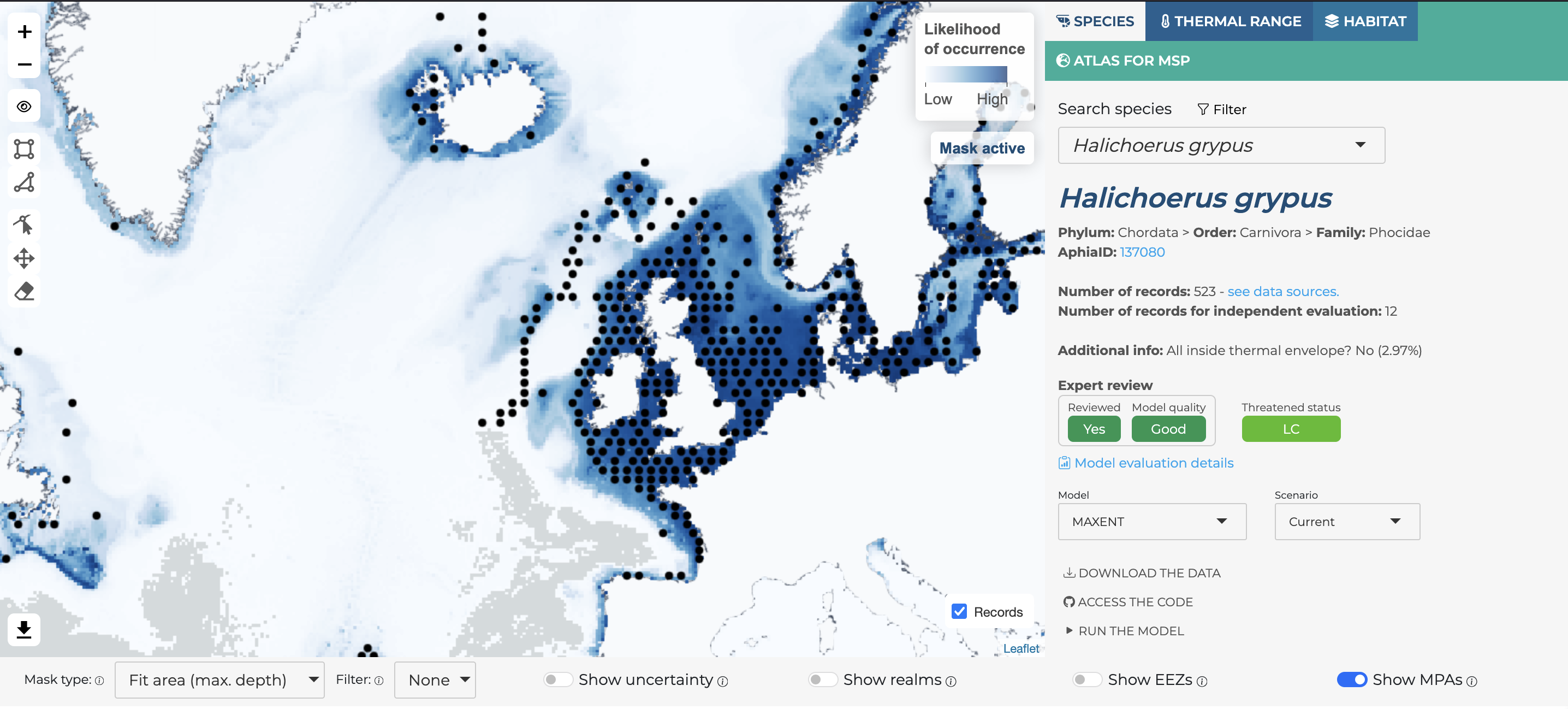
A view of the OBIS Species Distribution Models showing the current distribution of grey seals (Halichoerus grypus).
How the OBIS Species Distribution Models work: a multilayered approach to high-resolution, reliable predictions
The OBIS Species Distribution Models use a multistep process to deliver their output. At the beginning of its data pipeline, the SDMs assemble two kinds of inputs: occurrence records from OBIS and GBIF, and environmental variables. Once this data is ingested, the team assesses it for unusual, abnormal, and unlikely values, removes potential errors, and runs a post-assessment quality check on the remaining data.
After that step, the SDMs work on a 5 x 5 kilometer high-resolution grid to estimate, for each cell of that grid, where species and habitats are likely to be found. The models then use five future climate scenarios from the latest IPCC assessments to predict how the marine environment could change over time for the 2040-2050 and the 2090-2100 decades, and how much this could impact the species living in a given area.
At that stage, the team carries out additional quality checks focusing on the models’ outputs, such as verifying if a predicted location corresponds to the temperature range that a species is known to prefer, and comparing the results with other models to track discrepancies. Additionally, a permanent feedback loop is attached to the models’ outputs, allowing biodiversity experts around the world to directly assess and comment on the predictions and flag abnormal results or mistakes.
A powerful area-based management support tool that can be transposed anywhere
Based on Open Science and transparency, the OBIS Species Distribution Models produce reliable outputs that can cover numerous use cases, anywhere in the world. “Because they were developed within the MPA Europe project, we anchored the current SDMs in European waters and focused on European marine species,” said Pieter Provoost, OBIS Data Manager and another co-author of the Species Distribution Models. “We can transpose the OBIS Sspecies Distribution Models to any region, and change the scope of species for which we can output these predictions.”
In marine spatial planning, the OBIS SDMs can reveal the marine protected areas of tomorrow, support area-based management under the BBNJ Agreement, and produce evidence for the “30x30” target from the Kunming-Montreal Global Biodiversity Framework. The OBIS Species Distribution Models can also be used for climate adaptation and mitigation, as well as foresight to predict where marine species might migrate, disappear, or arrive. Because the OBIS Species Distribution Models combine species and habitats, they can also be used to predict the evolution of habitat-forming species, such as coral gardens, maerl beds, or seagrass meadows, and protect or restore the structures that other species depend on.
A short explainer video from the MPA Europe project describing how the OBIS Species Distribution Models work and what users can achieve.
To facilitate uptake, the interface of the OBIS Species Distribution Models was designed to accommodate a wide range of users. “We created a visually-driven interface supported by accessible documentation to make sure that anyone could use these SDMs,” said Silas Principe. “Our approach was to create a tool that could effectively answer some of the decision-makers’ needs for area-based marine management issues. The OBIS SDMs can directly inform them and provide the scientific foundation for evidence-based decision-making.” Most importantly, the OBIS Species Distribution Models provide provenance-tracked, trusted, transparent, verifiable, and reproducible predictions that decision-makers can cite.
A recognition for the work of the entire OBIS community
The OBIS Species Distribution Models, like any other model-based product, depend on high-quality in situ data to produce reliable results. The OBIS SDMs benefit from a long chain, where field observations have been cleaned, assessed, checked, formatted, standardized, curated, and published by scientists and citizens across the globe, before being made available and ready to be ingested.
“The OBIS Species Distribution Models could not exist without the joint effort of marine biodiversity data providers and the OBIS Nodes who make datasets available on our platform and on GBIF,” concluded Ward Appeltans, OBIS Programme Manager. “This recognition from the Ebbe Nielsen Challenge crowns a global community of more than 6,000 contributors. Each of them has a part in this success.” ◼️

